
Creating New Traditions without the Thanksgiving Turkey
Skipping the turkey at Thanksgiving builds a new kind of legacy for families.

Most of the people in my life are meat eaters which means that I share many meals with loved ones where there is chicken, fish, or beef on the table. For those of us who see the suffering behind these dishes, it can feel uncomfortable and that’s especially so on Thanksgiving.
There is something about a celebration that centers on – and insists on – the body of a dead animal that fills me with a particular sadness. It goes beyond even my usual sadness over the way we treat animals. For a couple of years my family went turkey free for Thanksgiving and that was lovely and uplifting. It was a gift to celebrate with the people I love in a way that honored the values that are deeply important to me. But life changes, and when our Thanksgiving dinner moved to a different home with new hosts, the turkey landed back on the menu.
And so, on this one day, while I miss my family, I choose personal comfort and compassion for animals, opting for a turkey-free celebration.
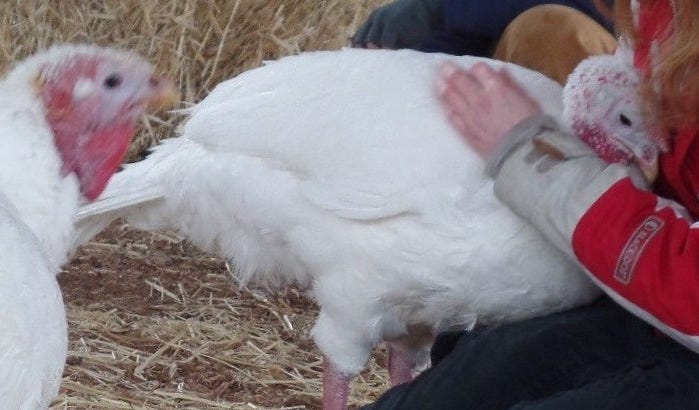
The hard truth is that there is a world of suffering behind traditional Thanksgiving dinners. Modern turkeys bred for meat endure miserable lives. Turkey farming is aimed at producing the largest number of birds for the lowest cost. Turkey growers know that the trade-off is the welfare of the animals. It is a given that some birds will die on the farm or enroute to slaughter and for farmers, the tragedy isn’t the death of the birds (their slaughter and sale is the whole purpose after all) but the financial loss. According to The Poultry Site:
“Losses from mortality accrue from the value of the turkey when it dies, which includes the feed it has consumed, and potential product market value. The most expensive mortality occurs when birds die enroute to the processing plant; least expensive mortality results from losses just after placement.”
Those turkeys who die “just after placement” include the millions of birds who die in the first weeks of life due to “starve-out” when they simply stop eating under the stressful conditions of the farm. If they survive the farm, they may die on the way to the slaughterhouse, traveling long distances with no food or water. And there are no federal laws in place to ensure that turkeys and chickens are humanely slaughtered.
Some people choose to purchase a turkey from a small local farm, and that’s certainly nicer for that turkey. But small farms can’t produce the 46 million animals killed for Thanksgiving every year. Buying a turkey from any kind of farm contributes to the belief that a happy Thanksgiving requires a turkey. It contributes to a culture of cruelty and disregard for animal lives.
In his 2009 book Eating Animals, Jonathan Safran Foer asks what it means when families decide to no longer serve a turkey.
“Would the choice not to eat turkey be a more active way of celebrating how thankful we feel? Try to imagine the conversation that would take place. This is why our family celebrates this way. Would such a conversation feel disappointing or inspiring? Would fewer or more values be transmitted? Would the joy be lessened by the hunger to eat that particular animal? Imagine your family’s Thanksgivings after you are gone, when the question is no longer “Why don’t we eat this?” but the more obvious one: “Why did they ever?”
For many years, I’ve made a new kind of Thanksgiving, and it never falls short. It is always a celebration of gratitude and abundance. And it’s also a celebration of compassion. Sometimes it’s just my husband and me in front of the fire, a cozy meal that I love. Sometimes I host a festive meal for friends. I love that, too. Either way, there is a feast, and it’s more traditional than you might imagine. Next week, I’ll share all my favorite tips for a cruelty-free Thanksgiving dinner that embraces tradition, gratitude, and good food.
Ginny, Yes! I never like being around animal products and for decades now the two times I can't be around animal based foods are Thanksgiving and any celebration of my birthday. Great piece!
Thank you for this piece. I find it abhorrent to celebrate over any meat centrepiece at a family feast. How do others not see what we see? Feel what we feel? I steel myself to attend and ignore the platters being passed by me. Thanksgiving, Christmas, Easter...
I have quit attending annual banquets with my colleagues as that is so much easier to say no to. With kids and family gatherings, I simply stand my ground, contributing vegan dishes,
and focussing on the gathering. But it is so very difficult. And deeply saddens me.